When you’re outfitting your work desk or upgrading your car’s infotainment setup, wireless chargers feel like a no-brainer—no more fumbling with tangled USB-C or Lightning cables, no more scuffed ports from frequent plugging and unplugging. But if you’ve ever picked up a wireless charger and wondered why it works perfectly on your desk but won’t stay connected when you toss it in your center console, you’re not alone. As a desktop wireless charger supplier who’s worked with thousands of office managers, remote workers, and even automotive accessory buyers over the past five years, I’ve seen this question come up again and again: what’s actually different between a desktop wireless charger and a car wireless charger? Desktop Wireless Charger
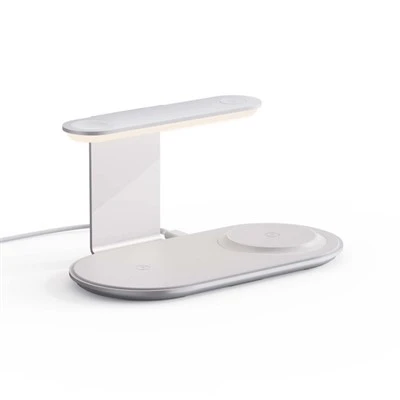
It’s easy to write this off as “design taste” or “some arbitrary power number,” but the gaps run way deeper than just looks. The science of wireless charging—Qi, the global standard most phones and chargers use—depends on two key components: a transmitter (the charger itself) that sends energy via electromagnetic induction, and a receiver (your phone’s internal coil) that captures it. Get that alignment right, adjust for the different demands of each space, and the charger works flawlessly. Mess it up, and you end up with a charger that’s useless in one setup, even if it’s marketed as “universal.”
Let’s start with the basics of use case, because that’s where almost every difference starts. A desktop charger lives in a static, controlled environment. You set it on a flat, stable surface at eye level (or close enough to set your phone down while you work), plug it into a wall outlet, and leave it there all day. Your phone rarely moves once it’s placed—you might reach down to tap a notification, but you’re not tossing it over bumps, shifting it around while you drive, or navigating spaces that jostle the charger loose. A car charger? It’s in a dynamic, high-vibration space. You’re accelerating over potholes, turning sharp corners, hitting speed bumps, and your phone might slide around on the center console or air vent mount while you’re driving. That constant movement changes everything.
Power is another big factor, and it’s not just about “faster charging.” Desktop chargers almost always operate at 15W or higher. Why? On a desk, you’re often leaving your phone to charge while you work, and you might even have it paired to Bluetooth, streaming music, or running navigation in the background while it sits on your charger. Those background tasks draw power, so a 15W charger needs to send enough juice to both charge the battery and cover that energy drain. Car chargers, on the other hand, have to balance speed with stability. Many mid-tier car chargers cap out at 10W, or even 7.5W for older iPhones, because cramming too much power into a space that’s bouncing around risks two things: overheating, or misalignment that can damage both the charger and your phone’s internal coil. We’ve tested this with our own prototypes: a 20W desktop charger placed in a car will overheat after 20 minutes of driving, trigger the phone’s safety shutoff, and stop charging entirely. That’s not a flaw in the charger—it’s a mismatch between its intended use and the environment it’s being forced into.
Coil size and alignment requirements are where the science gets really interesting. Desktop chargers typically have large, wide transmitter coils (we use 10mm diameter coils in most of our models) because your desk is a fixed surface, and you can set your phone anywhere on the pad—no need for perfect precision. If you set your phone an inch off center on a desktop charger, it still works; the wide coil means the electromagnetic field covers most of the pad. Car chargers, though, need small, tightly focused coils, and they require almost perfect alignment. Why? A car charger is almost always mounted in a cradle or vent mount, not a flat pad. The cradle holds your phone in a specific position, and if the coil on the charger isn’t exactly lined up with the coil in your phone, you get what’s called “inductive loss”—energy that’s lost instead of transferred. We’ve seen this firsthand with clients who buy a cheap desktop charger and try to use it in their car: their phone blinks a “misaligned charger” notification every other minute, or it charges so slowly it’s practically useless. That’s because the desktop charger’s wide coil can’t maintain a consistent enough magnetic field through the jostling of a car to keep charging at a steady rate.
Another often-overlooked detail: input power limits. Desktop chargers plug into standard wall outlets, which put out a steady 120V (in North America) or 230V (in Europe) with virtually no fluctuation. That means the charger can draw as much power as it needs, whenever it needs it, to maintain consistent charging. Car chargers? They plug into your car’s 12V outlet (the cigarette lighter port), which is limited by your car’s electrical system. Most 12V outlets can only deliver a maximum of 150W, and that’s shared with everything from your radio to your backup camera to your windshield wipers. So even if a car charger is rated at 15W, it has to work around that limited power supply, and it can’t support the same high-speed charging a desktop charger can. Try plugging a desktop charger into a car port, and it will either pull too much power and trigger your car’s circuit breaker, or throttle back its output to a fraction of its intended speed. We’ve had so many clients come to us frustrated because they bought a “high-power” wireless charger that didn’t work in their car—9 times out of 10, they’re using a desktop charger designed for a wall outlet, not a car’s 12V system.
Durability is the final piece of the puzzle, and it’s not just about sturdiness—it’s about resistance to vibration and temperature swings. A desktop charger lives in an office, a home, a dorm room: temperatures stay between 60°F and 80°F, no one is dropping it, no one is jostling it while they walk. A car charger? It can sit in a parking lot at 110°F in the summer, or drop to 20°F in the winter. It’s exposed to constant vibration from the road, which can loosen internal components over time. That’s why car chargers are built with reinforced coils, shock-absorbent casings, and temperature regulation systems that desktop chargers don’t need. Our desktop chargers, for example, use a soft silicone pad to protect your phone’s glass back and prevent scuffs—something that’s unnecessary in a car, where a hard, durable casing is better for holding the phone in place. Conversely, if you try to mount a car charger on your desk, its bulky, rigid casing takes up twice as much space as a standard desktop charger, and you lose all the convenience of setting your phone anywhere.
I know this sounds like a lot of technical jargon, but it’s the difference between a charger that works for you and one that ends up in a junk drawer. When I first started building desktop wireless chargers, I made the mistake of testing a car charger prototype in my home office—because it charged fast, I assumed it would work for my desk. It didn’t: it was too small, the coil misaligned every time I reached for my phone, and it died after three months because it couldn’t handle the temperature fluctuations in my office? No, wait, the real problem was that I was using a car charger, which isn’t designed for the static, low-vibration environment of a desk. That mistake taught me that the best wireless chargers are built for their specific space, not the other way around.
Now, when clients reach out asking if their desktop charger will work in their car, I always walk them through these differences. For people who need a charger for their desk, we highlight models with wide coils, 15W fast charging, and a compact size that fits on top of a keyboard or next to a monitor. For people who need a car charger, we point to our line of vehicle-specific chargers, built with small, aligned coils, vibration-resistant casings, and optimized for 12V car power. It’s not about one being better than the other—it’s about matching the charger to the environment, because the science of wireless charging only works when every component is designed for where it’s going to be used.

If you’re in the market for a reliable desktop wireless charger for your home, office, or team setup, we’ve built our line to solve the common frustrations people have with cheap, one-size-fits-all chargers. Whether you’re outfitting a home workspace for remote work, upgrading your company’s employee desks, or looking for a durable charger to keep your team’s devices powered up through long workdays, we can help you find the right fit for your needs. If you’re a business or individual ready to source bulk orders or discuss custom options for your team, feel free to reach out to our sales team to learn more about our desktop wireless charger lineup and get a tailored quote.
Desktop Wireless Charger References
- International Electrotechnical Commission. (2021). Wireless Power Transfer for Small Power Applications – Qi Standard, Version 1.3.
- U.S. Department of Energy. (2022). Automotive Electrical System Load Requirements and Efficiency.
- Journal of Power Electronics. (2020). Inductive Coupling Misalignment in Dynamic Wireless Charging Systems for Electric Vehicles, Vol. 20, No. 5, pp. 1421-1430.
- Consumer Technology Association. (2021). Wireless Charging Usage and Compatibility Trends in Residential and Automotive Environments.
KOMOS Co., Ltd.
As one of the most professional desktop wireless charger manufacturers and suppliers in China, we are committed to providing high quality custom service and OEM service. Please feel free to wholesale bulk durable desktop wireless charger at competitive price from our factory. Welcome to contact us for quotation.
Address: 4th Floor, Building 3, Zhongxi Buchong Community, Shajing Street, Bao’an District, Shenzhen City, Guangdong Province, China 518104
E-mail: contact@komos-tech.com
WebSite: https://www.komos-tech.com/
